
When developing a sanitary pad, buyers often focus on the topsheet, length, thickness, or packaging. But one of the most important components inside the product is the absorbent core.
Super Absorbent Polymer (SAP) is widely used in absorbent hygiene products because of its ability to absorb and retain large amounts of liquid. In sanitary pads, SAP can contribute to absorption capacity, liquid retention, and thinner absorbent-core designs. However, the performance of a sanitary pad does not depend on SAP alone. The SAP type, quantity, distribution, wood pulp, core structure, and manufacturing process all work together.
For OEM and private-label brands, the key question is therefore not simply “How much SAP does this pad contain?” but:
How is SAP optimized within the entire absorbent system?
This guide explains what SAP does, how it works with other absorbent materials, what specifications matter, and what buyers should discuss with a sanitary pad manufacturer before mass production.
1. What Is SAP in Sanitary Pads?
SAP stands for Super Absorbent Polymer.
It is a highly absorbent polymer material designed to absorb and retain liquid. Many commercial SAPs used in hygiene products are based on cross-linked polyacrylate materials, including sodium polyacrylate.
When SAP comes into contact with liquid, it absorbs the liquid and swells into a gel-like structure. This helps retain fluid within the absorbent core rather than allowing it to remain freely mobile.
In a sanitary pad, SAP is typically incorporated into the absorbent core together with other absorbent materials such as cellulose fibers or fluff pulp.
In simple terms:
Liquid enters the pad → moves through the acquisition/distribution layer → reaches the absorbent core → SAP absorbs and retains part of the liquid.
This is one reason SAP is important when developing thin, high-absorbency sanitary pads.
2. Why Is SAP Important in Sanitary Pads.
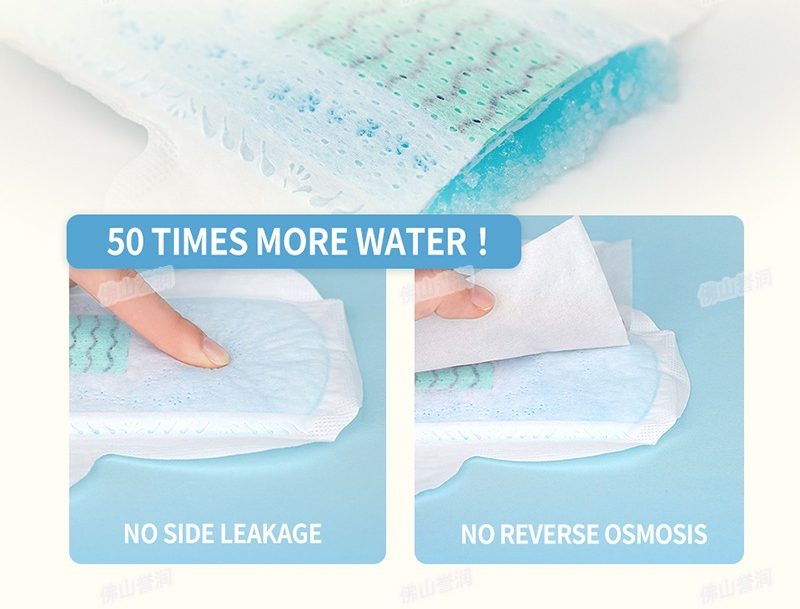
2.1 Absorption Capacity
SAP can absorb a large quantity of liquid relative to its own weight. This makes it useful when a product needs to provide high absorbency without relying entirely on a bulky absorbent core.
For OEM buyers, however, it is important to distinguish between the absorption capacity of SAP as a raw material and the absorption performance of the finished sanitary pad.
A high-capacity SAP does not automatically create a high-performance pad.
2.2 Liquid Retention
After absorbing liquid, SAP forms a swollen gel structure that helps retain the liquid within the absorbent core.
This retention function is particularly relevant to products designed for heavier menstrual flow or longer wear periods.
However, retention performance depends on the entire core structure and test conditions, not just the SAP itself.
2.3 Supporting Thinner Pad Designs
One major reason SAP is valuable in modern absorbent hygiene products is its ability to provide substantial liquid absorption and retention in a relatively small amount of material.
This can support the development of ultra-thin sanitary pads when SAP is properly combined with the appropriate absorbent fibers and core structure.
But thinness should not be achieved simply by removing absorbent materials.
The objective is to create an efficient absorbent system.
3. SAP vs. Wood Pulp: What’s the Difference?
One of the most common misunderstandings in sanitary pad development is treating SAP and wood pulp as interchangeable materials.
They perform different functions.
| Material | Main Contribution |
| SAP | Liquid absorption and retention |
| Wood pulp / fluff pulp | Fluid acquisition, distribution and core structure |
| Acquisition & Distribution Layer (ADL) | Helps receive and distribute incoming liquid |
| Core wrap / tissue | Helps maintain the absorbent core structure |
| Topsheet | Allows liquid to pass into the absorbent structure |
| Backsheet | Helps prevent liquid from passing through to clothing |
Commercial sanitary pad absorbent cores may use cellulose fibers, SAP, or combinations of absorbent materials. The overall structure is designed to absorb, transport, distribute, and retain fluid.
SAP does not simply replace wood pulp.Instead, the two can work together.
Wood pulp can help with: Liquid acquisition/Fluid distribution/ Wicking / Core structure
SAP can contribute to: High absorption capacity /Liquid retention /More compact absorbent structures
Therefore: SAP and wood pulp are complementary components of an absorbent core, not simply competing materials.
The right balance depends on the target product.
4. Is More SAP Always Better?
No.
This is one of the most important points for sanitary pad buyers to understand. It may seem logical that increasing the amount of SAP will automatically increase absorbency. In practice, absorbent-core performance depends on how liquid moves through the entire structure. If SAP swells too quickly or becomes concentrated in certain areas, it can affect further liquid distribution through the core. Research on SAP technology has specifically examined issues such as absorption under pressure and gel blocking, which can influence overall absorbent performance.
Think of SAP optimization in three stages:
Too Little SAP
Potential challenges: 1. Lower absorption capacity 2.Greater dependence on bulky absorbent materials 3.Difficulty achieving certain thin-product targets
Optimized SAP
Potential benefits: 1.Balanced absorption and retention 2. Efficient use of absorbent-core space 3.Better compatibility with thin-pad designs 4.Controlled material cost
Too Much SAP
Potential challenges: 1. Uneven liquid distribution 2. Core structure challenges 3. Possible gel-blocking effects 4.Higher material cost
Therefore, the goal is not: Maximum SAP. The goal is: Optimized SAP for the entire absorbent core.
5. What SAP Specifications Matter to OEM Buyers?
When discussing SAP with a sanitary pad manufacturer, buyers should look beyond the simple question of “How many grams of SAP are used?”
Several material and performance characteristics can matter.
5.1 Absorption Capacity
This indicates how much liquid the SAP can absorb under a defined test method.
However, test conditions matter. Results obtained with pure water may differ from those obtained with saline or other test liquids.
For this reason, buyers should always ask about the test method and conditions when comparing data.
5.2 Absorption Under Pressure
A sanitary pad is used under pressure from the body, clothing, sitting, movement, and other conditions.
Therefore, free absorption capacity alone does not tell the complete story.
Absorption-under-load testing can provide additional information about how the absorbent material performs under pressure. SAP research commonly evaluates absorption under load as an important performance parameter.
5.3 Absorption Speed
Fast absorption helps liquid move away from the surface and into the absorbent structure.
However, fast absorption by SAP alone is not enough.
The topsheet, ADL, pulp, SAP distribution, and core structure must work together to transport liquid efficiently.
5.4 Liquid Retention
A good absorbent system needs not only to take in liquid, but also to retain it.
This is particularly relevant when evaluating: 1.Heavy-flow pads 2.Overnight pads 3. Long-wear products 4.Menstrual pants
5.5 SAP Distribution
The amount of SAP is only part of the equation.
Where the SAP is located inside the absorbent core also matters.
Uneven distribution can result in localized saturation while other parts of the core remain underutilized.
For OEM development, SAP distribution should therefore be considered together with:
Core dimensions / Pulp distribution / ADL structure / Embossing / Target absorption area / Product shape
6. How SAP Works with the Entire Sanitary Pad Structure

A sanitary pad is a multi-layer absorbent system. A simplified structure can be represented as:
Topsheet
↓
Acquisition & Distribution Layer
↓
Absorbent Core
↓
Backsheet
Within the absorbent core:
SAP + Wood Pulp / Other Absorbent Materials
Each layer has a different role.
The topsheet receives menstrual fluid and allows it to pass into the internal structure. The ADL can help distribute incoming fluid. The absorbent core absorbs and retains the liquid, while the backsheet helps prevent leakage through the bottom.
This leads to an important OEM development principle:
Good SAP + poor core design does not automatically create a good sanitary pad.
The final performance depends on how the entire structure works together.
7. How Do Manufacturers Control SAP Quality?
For OEM and private-label products, SAP selection is only the first step.
A reliable manufacturing process should control the material and the finished product throughout production.
Step 1: Incoming Material Inspection
The manufacturer verifies incoming raw materials according to established specifications.
This can include material identity, batch information, appearance, and relevant supplier documentation.
Step 2: SAP Specification Control
The SAP used for production should be consistent with the approved product specification.
This is particularly important when a brand has approved a specific absorbent-core structure.
Step 3: Core Production Control
During production, manufacturers need to control the absorbent-core structure, including material quantity and distribution.
The objective is to keep the absorbent structure consistent from batch to batch.
Step 4: Finished Product Testing
The finished sanitary pad should be evaluated as a complete product.
Depending on the product specification, testing may include: Absorption capacity / Absorption speed / Rewet / Leakage performance / Product weight / Thickness / Dimensional consistency / Appearance / Packaging integrity / Testing the SAP alone is not enough.
OEM buyers should evaluate the finished sanitary pad, not only the raw material.
8. SAP and Ultra-Thin Sanitary Pads
Ultra-thin sanitary pads are a good example of why absorbent-core engineering matters.
Consumers may want a product that is:
Thin + Comfortable + Highly Absorbent + Leak-Protective
These requirements need to be balanced.
SAP can help increase absorption and retention within a compact absorbent structure, but the final result also depends on the distribution of liquid throughout the core.
For an ultra-thin OEM product, manufacturers may need to consider: SAP selection / SAP distribution / Wood pulp or other absorbent fibers / ADL design / Core thickness / Embossing pattern / Absorption area / Product dimensions / Target absorbency
This is why core customization can be more important than simply specifying a high SAP content.
9.A Practical SAP Checklist for OEM Buyers
Before mass production, confirm the following:
| Item | What to Confirm |
| SAP Type | Approved material and specification |
| SAP Performance | Absorption and retention requirements |
| Core Structure | SAP + pulp / other absorbent materials |
| SAP Distribution | Consistent distribution within the core |
| Target Thickness | Finished-pad thickness |
| Target Absorbency | Defined test method and target |
| Rewet | Defined acceptance criteria |
| Leakage | Defined test conditions |
| Product Weight | Target and tolerance |
| Golden Sample | Approved reference sample |
| Pilot Production | Small-batch verification before mass production |
| QC Standard | Incoming, in-process and finished-product inspection |
| Batch Consistency | Defined tolerance and testing method |
The more clearly these specifications are defined before production, the easier it is to maintain consistent product quality across future batches.
Conclusion
SAP is an important component of sanitary pad performance, but effective absorption depends on the entire absorbent-core system. The right combination of SAP, absorbent fibers, core structure, and manufacturing control helps achieve the required balance of absorbency, thinness, comfort, and leakage protection.
For OEM and private-label brands, the goal is not to maximize SAP, but to optimize the absorbent core for the specific product. With customized material selection, core design, and quality control, manufacturers can develop sanitary pads tailored to different flow levels, product formats, and market requirements.