
Choosing disposable period pants for a private-label brand involves more than selecting S, M, L, or XL. A well-designed period pant needs to fit the target consumer’s body shape, provide comfortable stretch, maintain secure contact around the waist and legs, and position the absorbent core correctlyFor OEM buyers, the key question is not simply “What sizes are available?” but:
“How should the size, pattern, elasticity, coverage, and absorbent core be designed for my target market?”This guide explains the key factors to consider when developing private-label disposable period pants, from size selection and pattern design to elasticity, fit testing, and OEM customization.
What Should OEM Buyers Consider When Choosing Disposable Period Pants?
A suitable disposable period pant should be developed around five main factors:
- Target consumer
- Size range
- Body shape and fit
- Intended use
- Product positioning
For example, an overnight period pant may require greater coverage and a more secure fit, while a lightweight daily product may prioritize flexibility and comfort.
For OEM development, these factors should be considered together rather than selecting a standard size chart first and adjusting the product afterward.
Why Does Fit Matter in Disposable Period Pants?
Unlike traditional sanitary pads, disposable period pants are worn as underwear.
The product needs to stay in position while the user:
- Walks
- Sits
- Moves
- Sleeps
- Changes position
Poor fit can affect both comfort and protection.
A waistband that is too tight may create excessive pressure, while a waistband that is too loose may reduce the feeling of security. Similarly, a loose leg opening may affect leakage protection, while excessive compression may cause discomfort.
This is why:
For disposable period pants, fit is part of product performance—not simply a sizing issue.
What Is the Difference Between Size and Fit?
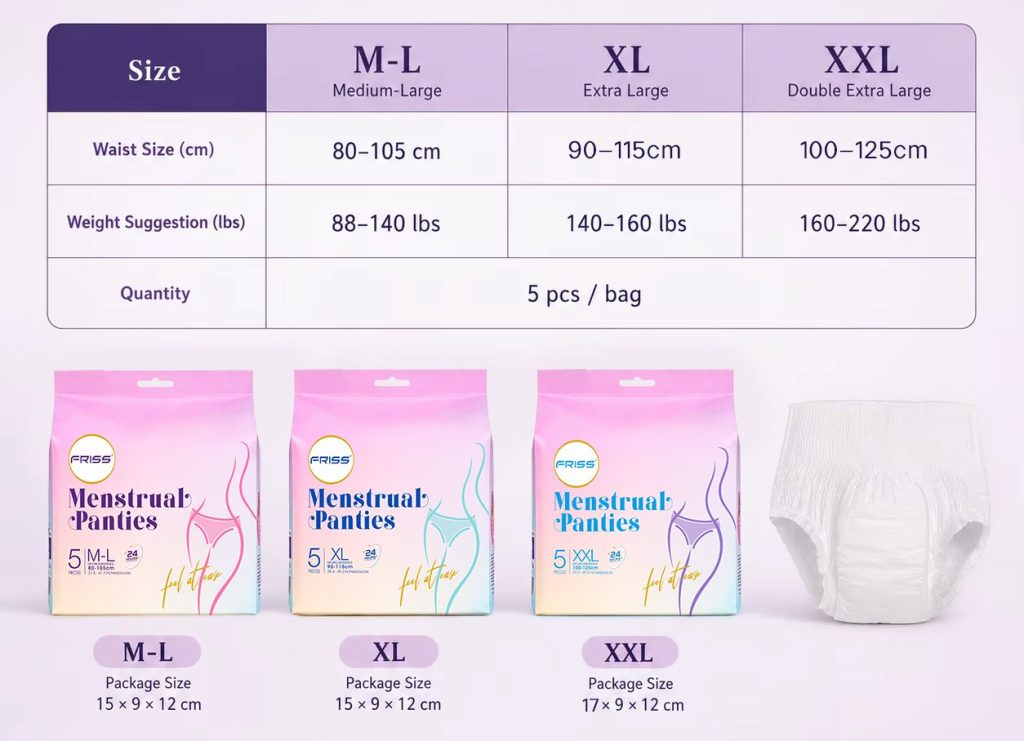
Size describes the measurement range a product is designed to accommodate.
Fit describes how the product actually sits on the body.
These are related, but they are not the same.
For example, two products may both be labeled Size L, but they can have different:
- Waist widths
- Hip widths
- Rise lengths
- Leg openings
- Elasticity
- Overall coverage
As a result, they may feel very different when worn.
For private-label brands, a size label alone is therefore not enough to define a product.
A more complete specification should include:
Size + Product Measurements + Stretch Range + Pattern Design + Fit Testing
How to Choose the Right Size for Disposable Period Pants?
The right size should generally be determined by body measurements and the product’s stretch range, rather than weight alone.
The key measurements may include:
Waist Circumference
Important for determining waistband fit and overall comfort.
Hip Circumference
Important because the period pant needs to cover and fit around the hips and buttocks.
Rise
The distance from the waist area through the crotch affects how the product sits on the body.
Leg Opening
The leg opening needs to provide sufficient coverage and close contact without excessive pressure.
Product Length
Overall length affects front and back coverage and should be considered together with the intended use.
For an OEM product, the final size range should be established through sample development and fit testing rather than relying only on a generic S/M/L standard.
Should Period Pants Be Sized by Waist or Hip?
Both should be considered.
Waist measurement is important for waistband fit, but it does not fully describe body shape.
Two consumers can have a similar waist circumference but different:
- Hip circumference
- Hip-to-waist ratio
- Rise requirements
- Leg circumference
- Body proportions
Therefore, an OEM size specification should ideally consider:
Waist + Hip + Rise + Leg Opening + Product Stretch
This provides a more complete basis for pattern development.
Why Is Elasticity Important in Period Pant Sizing?
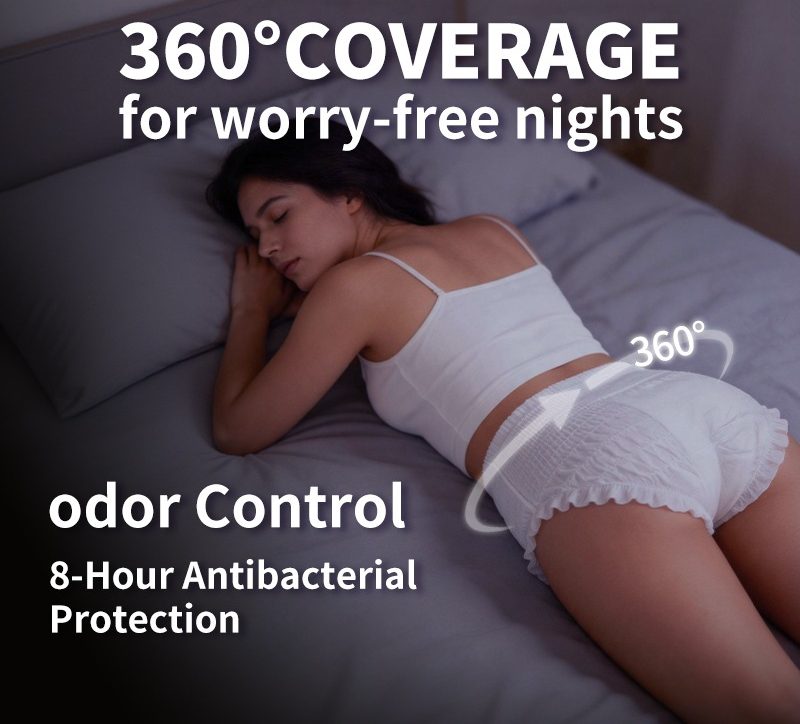
Elasticity is one of the factors that can make two products with similar measurements feel completely different.
The final fit can be influenced by:
- Elastic material
- Elastic width
- Elastic density
- Elastic placement
- Fabric stretch
- Waistband construction
- Leg elastic construction
For example, a product with a relatively smaller flat measurement may still accommodate a wider range of body measurements if its elastic structure provides sufficient stretch.
Therefore:
A flat measurement does not tell the complete story of how a disposable period pant will fit.
OEM buyers should ask manufacturers about both the finished product measurements and the stretch range.
What Are the Main Pattern and Elastic Designs for OEM Period Pants?
Different pattern and elastic structures can be developed for different product positioning.
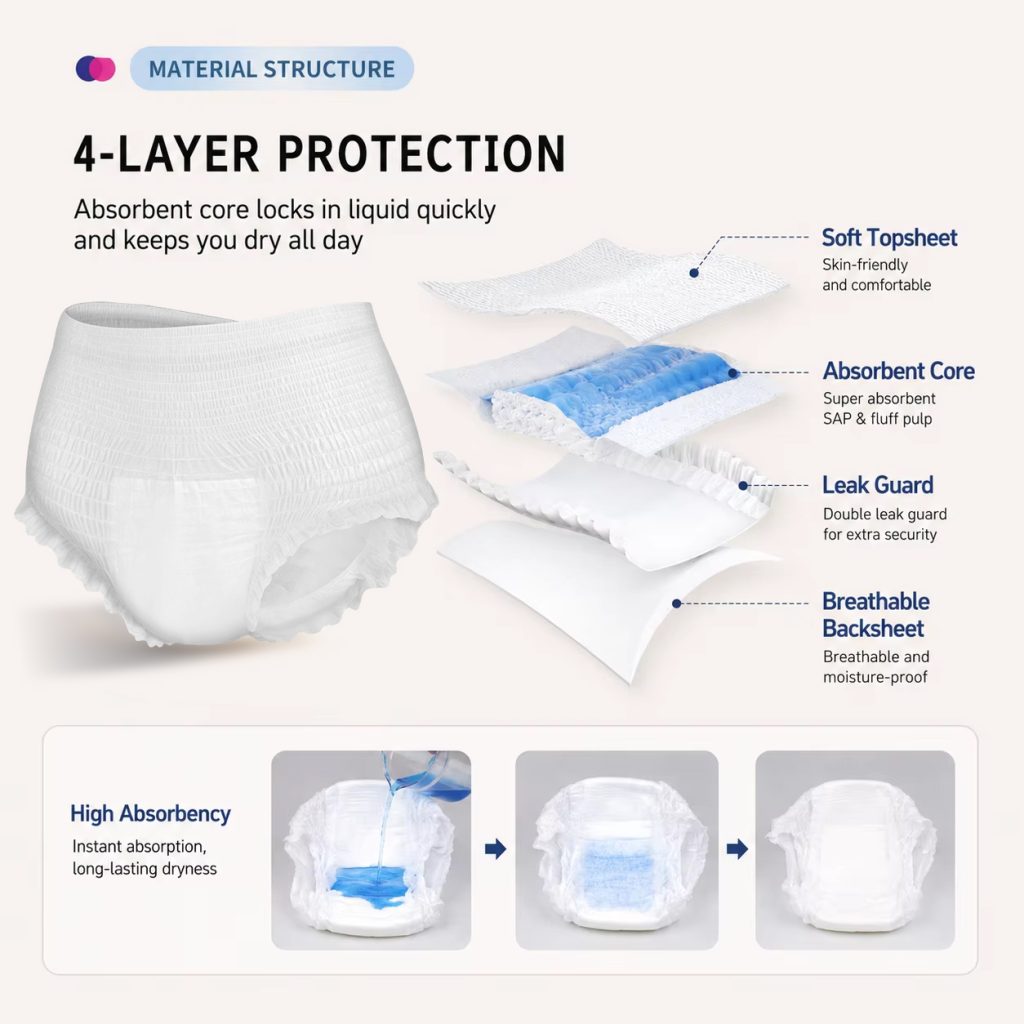
1. Wide-Spaced Elastic Design
This structure uses wider spacing between elastic components.
Potential characteristics include:
- Flexible fit
- Comfortable movement
- Everyday wear positioning
It may be suitable for brands prioritizing softness and flexibility.
2. Wide + Close Elastic Combination
Different elastic zones can be combined within the same product.
This allows the manufacturer to adjust the balance between:
- Support
- Stretch
- Body contact
- Comfort
It can be considered when a brand wants different levels of elasticity in different areas.
3. Close Elastic Design
A closer elastic structure can provide a more secure body fit.
It may be considered for products where close contact and stability are important, such as products designed for overnight or higher-protection use.
However, the final fit still depends on the elastic material, pattern and size specification.
4. Seamless Elastic Design
Seamless or low-profile elastic structures can be developed for products where a smoother appearance and comfortable wear are priorities.
They may be suitable for:
- Premium positioning
- Comfort-focused products
- Products designed to reduce visible lines under clothing
The appropriate design depends on the target consumer and product positioning.
How Should the Waistband Be Designed?
The waistband needs to balance security and comfort.
Important design variables include:
- Waistband height
- Elastic width
- Elastic stretch
- Elastic recovery
- Waistband placement
- Softness of the material
For example, a wider waistband can provide broader contact with the body, while different elastic structures can change the pressure distribution.
For private-label development, the waistband should be evaluated during actual fit testing rather than judged only from product drawings or flat samples.
How Should the Leg Opening Be Designed?
The leg opening is another important area of period pant design.
A suitable leg opening should provide:
Close contact + Flexibility + Comfort
If the opening is too loose, the product may not maintain close contact with the body.
If it is too tight, it may create excessive pressure or discomfort.
OEM manufacturers may customize:
- Leg circumference
- Elastic type
- Elastic tension
- Single or double leak guards
- 3D leakage barriers
The appropriate combination depends on the product’s intended use and target fit.
Does the Rise and Coverage Affect Period Pant Performance?
Yes.
Rise affects how the product sits vertically on the body, while front and back coverage affect the protected area.
This is particularly important when developing overnight period pants.
A product designed for overnight use may require consideration of:
- Higher rise
- Extended back coverage
- Larger absorbent area
- Secure leg fit
- Stable waistband
However, these features should be optimized together with the product’s overall pattern and absorbent-core design.
How Does the Absorbent Core Affect the Fit?
The absorbent core is not only a performance component—it can also affect the overall construction and feel of the period pant.
Important considerations include:
- Core dimensions
- Core thickness
- Absorbent material
- SAP and/or wood pulp
- Core position
- Absorbent area
- Front-to-back coverage
For example, a high-absorbency overnight period pant may require a larger absorbent area than a lighter daily product.
The core therefore needs to be designed together with the pattern rather than treated as a completely separate component.
The pattern, elastic structure, and absorbent core should be developed as one product system.
How Should Period Pants Be Designed for Different Uses?
There is no single period pant design that is ideal for every application.
The design should match the intended use.
| Product Use | Key Design Considerations |
|---|---|
| Daily Period Protection | Comfort, flexibility, balanced coverage |
| Overnight Period Pants | Secure fit, back coverage, absorbent area, leakage protection |
| Heavy-Flow Period Pants | Absorbent capacity, core area, fluid distribution, secure fit |
| Postpartum / Maternity Care | Soft materials, coverage, gentle fit, absorbency |
| Emergency Protection | Coverage, absorbency, secure fit |
| Long-Wear Products | Comfort, retention, leakage protection and durability |
These are design considerations rather than universal specifications. The final structure should be validated through product development and fit testing.
How Do You Develop the Right Size Chart for OEM Period Pants?
A private-label size chart should ideally be developed through a structured process.
| Step 1: Define the Target Market | Step 2: Define Body Measurements | Step 3: Develop the Pattern |
| Determine:Target country or regionTarget consumer groupIntended useExpected size range | Identify the key measurements for the target size range:WaistHipRiseLeg circumference | The pattern should be developed according to:Body measurementsProduct dimensionsFabric stretchElastic structureAbsorbent-core dimensionsIntended coverage |
| Step 4: Make Samples | Step 5: Conduct Fit Testing | Step 6: Adjust the Pattern | Step 7: Approve the Golden Sample |
| Produce samples for each key size. | Evaluate:Waist fitHip fitLeg openingFront coverageBack coverageMovementSittingWalkingSleeping | Based on the fitting results, the manufacturer can adjust the:PatternElasticityDimensionsCore positionCoverage | Once the fit and product specifications are confirmed, the approved sample can serve as a reference for mass production. |
What Should an OEM Period Pant Specification Include?
A professional OEM specification should go beyond simply stating the size.
Product Dimensions
- Waist width
- Hip width
- Overall length
- Front rise
- Back rise
- Leg opening
Material
- Topsheet
- Absorbent core
- Backing film
- Elastic material
Fit
- Stretch range
- Waist elasticity
- Leg elasticity
- Pattern structure
Absorbent Performance
- Target absorbency
- Rewet requirements
- Leakage protection
- Core dimensions
Packaging
- Individual wrapping
- PE bag
- Aluminum foil bag
- Box
- Pack quantity
The more clearly these specifications are defined before production, the easier it is to maintain consistency between samples and mass-produced products.
Common Mistakes When Choosing Private-Label Period Pants
Mistake 1: Choosing Size Only by Weight
Body weight does not fully describe waist, hip, rise, or body proportions.
Better approach: Use body measurements together with the product’s stretch range.
Mistake 2: Copying Another Brand’s Size Chart
Different brands can use different patterns, materials, elastic structures and sizing systems.
Better approach: Use competitor products as market references, then develop your own product measurements through sampling and fit testing.
Mistake 3: Focusing Only on Waist Size
Waist measurement is important, but hip, rise and leg opening also affect fit.
Better approach: Evaluate the entire body-contact area.
Mistake 4: Ignoring Stretch Range
Two products with the same flat measurement can have different usable size ranges because of their elastic structures.
Better approach: Confirm both flat dimensions and stretch performance.
Mistake 5: Approving a Sample Without Fit Testing
A product may look good on a flat table but feel different when worn.
Better approach: Include actual fit testing before final approval.
Mistake 6: Using One Pattern for Every Product
Daily, overnight, heavy-flow and postpartum products may have different design requirements.
Better approach: Develop the pattern according to product positioning and intended use.
Frequently Asked Questions
What size disposable period pants should I choose?
The appropriate size should be determined primarily by body measurements such as waist and hip circumference, together with the product’s stretch range and sizing specification. Weight alone is not sufficient to determine fit.
Should period pants be sized by waist or hip?
Both should be considered. Waist affects waistband fit, while hip circumference, rise and leg opening also affect the overall fit.
Are disposable period pants the same size as regular underwear?
Not necessarily. Different brands may use different sizing systems, patterns, materials and stretch ranges. Buyers should compare actual product measurements rather than assuming underwear sizes will be identical.
Can OEM manufacturers customize period pant sizes?
Yes. OEM manufacturers can develop customized size ranges and product measurements according to the target market, consumer requirements and product positioning.
Can the pattern of disposable period pants be customized?
Yes. Pattern dimensions, rise, coverage, waistband structure, leg opening and elastic configuration can be developed according to the product requirements.
What measurements should be included in a period pant size chart?
A detailed specification can include waist, hip, overall length, front rise, back rise and leg opening. Stretch range should also be considered.
How should I test the fit before mass production?
Fit testing should evaluate the waistband, hips, leg openings, front and back coverage, movement, sitting, walking and sleeping. The results can then be used to adjust the pattern and elastic structure before the Golden Sample is approved.
What should I ask an OEM manufacturer before ordering period pants?
Ask about available size ranges, product measurements, stretch range, pattern customization, elastic structure, absorbent-core design, leakage protection, sample development, fit testing, MOQ and mass-production quality control. you can visit Yurun Private Label- Disposable period panties to discover more customized manufacturing solutions..