
Introduction|From an Idea to a Market-Ready Sanitary Pad
However, for foreign companies, the process of creating a new sanitary pad can be quite complicated. Many brands lack their own production lines, while others are unsure whether sanitary pad OEM or ODM is the right option for their business. In addition, they may face challenges in customizing product structures, controlling MOQ and production costs, and launching new sanitary pad products quickly while ensuring stable supply and consistent quality.
All these challenges require finding a proper manufacturing partner who will take care of your problems and help you to create a product. Such a sanitary napkin manufacturer should not only produce your sanitary napkins but also take care of the development of a product, materials selection, customization, packaging, quality control, and delivery.
What Are OEM, ODM and Private Label Sanitary Pads?
Original equipment manufacturer, original design manufacturer, and private label are the three models that are often utilized by brands while designing and manufacturing sanitary pads. It is essential for buyers to comprehend the operations of these models in order to select the right manufacturing process.
OEM Sanitary Pads: Your Specifications + Our Manufacturing
The OEM sanitary pads are manufactured based on the customer’s requirements. The customer can offer a sample of the sanitary pads, specifications, materials used, structure of the product, size, and packaging. After that, the manufacturer makes sanitary pads based on the requirements approved.
This method offers high control of the end product by the customers. This method is suitable for well-established brands that have a product idea or sanitary pads that need manufacturing under their brand name.
ODM Sanitary Pads: Our Product Solutions + Your Brand
ODM sanitary pads are designed on the basis of product solutions and development possibilities of the manufacturer. In contrast to giving all details at once, the customer is able to choose from the range of product solutions, product structures, material combinations, functional technologies, and packaging solutions provided by the manufacturer.
Afterwards, the customer is able to make changes according to its own brand positioning and target audience and sell its own branded product. Such an approach might be especially effective for young and developing brands who wish to reduce product development period.
Private Label Sanitary Pads: Your Brand + Our Manufacturing
Sanitary pads private label is a product that is branded by the customer himself while being designed and produced by a third party manufacturer.
Private labeling may be based either on the existing ODM solution or on the customized OEM product. Thus, a brand may choose the existing product solution and customize it for their needs or create a more customized product based on their requirements.
OEM vs ODM: What’s the Difference?
Both OEM and ODM provide a way for the brand to manufacture private label sanitary pads; however, there is a difference in the roles of the customer and the manufacturer. The below table highlights the difference.
| OEM | ODM | |
| Product concept | Customer-led | Manufacturer-supported |
| Product design | Customer specification | Manufacturer’s solution |
| Customization | High | Flexible |
| Product development | Joint development | Manufacturer-led |
| Suitable for | Existing brands | New & growing brands |
| Development time | Usually longer | Usually faster |
| Private Label | Yes | Yes |
Overall, OEM will be more appropriate when the brand already has a certain idea of what their product should be like. Conversely, ODM will be more appropriate when the brand would like to utilize the product solutions and development capabilities of the manufacturer to launch a product.
What Can You Customize with a Sanitary Pad Manufacturer?
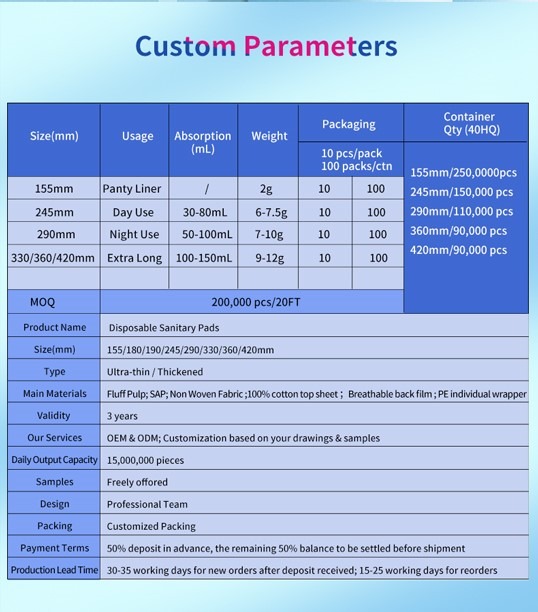
Customization is an essential process in the manufacturing of private label sanitary pads. Based on the capabilities of the manufacturer, various product and packaging specifications may be discussed.
Product Size and Structure
The brand can convey its desired size and construction of the sanitary pads based on its target audience and positioning. The OEM client will have a sample or specifications for the same, whereas the ODM client will have an existing product solution that needs changes.
The manufacturer will then analyze the requirements and decide how they can be included in the production process.
Materials and Product Components
It is also possible to tailor the material selection based on the agreed product specifications. While the customer can specify material specifications for an OEM design project, the customer for an ODM design project can choose the materials available with the manufacturer.
The final material combination should be assessed alongside the product structure and manufacturing process.
Packaging Requirements
Packaging is another significant aspect of private labeling customization. The customer can give their specifications and branding information so that the manufacturer can design the packaging alongside the sanitary pads.
Having product and packaging development coordinated early on can minimize changes prior to mass production.
Leak Protection & Pad Structure Customization
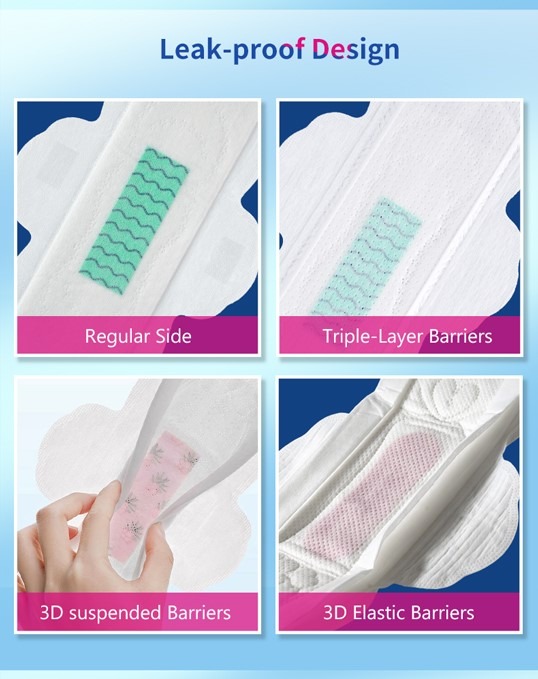
In the case of sanitary pads, the product structure has a direct connection with protection and usability. Hence, it is advised that the brand should consider the entire structure of the pad rather than just one part of it.
Absorbent Structure
Customization of the absorbent structure is possible based on the product requirement. In case of OEM client, an existing product structure can be provided for evaluation, while ODM supplier may suggest a suitable structure based on the existing product solution.
The chosen structure must be compatible with the product positioning and stable production.
Wing and Side Protection
Wing design and side protection could also be taken into consideration when designing sanitary pads. These factors are part of the overall product design and could be customized based on the needs of the customer.
It is important for the manufacturer to consider all the factors such as wing design, side protection, size, and absorbent design.
Overall Pad Structure
The structure of sanitary pads may vary depending on the kind of pads to be produced. The company can have a discussion with the customer during product development about the materials, absorber structure, protectors, and other components used.
This will ensure that the custom-made product fits the needs of the brand and is also feasible for manufacturing.
Pattern/Functional Chip Sanitary Pad Customization
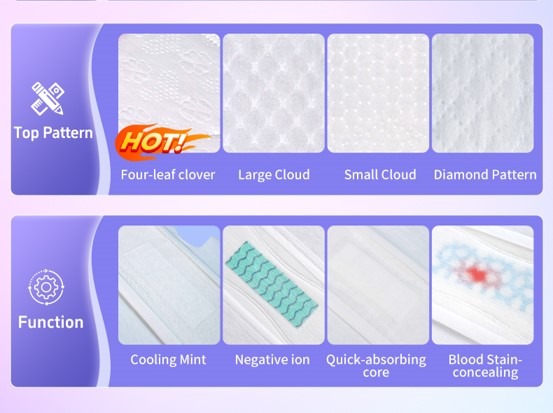
Beyond basic product structure, some brands may also want to differentiate their sanitary pads through patterns or functional features.
Pattern Customization
Customization of patterns can help in making the private label sanitary pad appear more unique. The brand can communicate its design idea to the manufacturer for inclusion in the product.
The pattern must be verified at the stage of sample development so that the end product can be examined before mass production.
Functional Chip Customization
Chip functional sanitary pads can be manufactured once the customer demands such a feature from the product. It is necessary for the manufacturer to understand the requirements of the client and find out ways of integrating the chip into the product design and manufacturing.
It is important for the exact chip functional technology to be identified based on the product requirements of the customer and not just assumed at the quotation level.
The Sanitary Pad OEM/ODM Manufacturing Process
A proper OEM or ODM project must go through a well-defined development process. This process consists of eight main steps.
Step 1 — Brand Positioning
The manufacturer understands the brand, market, concept, and positioning. This understanding is important in defining the product requirements, needs of the customers, and the direction of development.
Step 2 — Product Discussion
The customer and manufacturer discuss the product requirements, including specifications, materials, structure, size, packaging, MOQ, and other customization requirements.
Step 3 — Sample Analysis / Development
An existing sanitary pad sample can be analyzed for an OEM project, while an ODM project can start from an existing product solution.
Step 4 — Product Customization
The product is adjusted according to the confirmed specifications, including the required structure, materials, size, pattern, functional features, and packaging.
Step 5 — Sample Production
Samples are produced for the customer to evaluate. Any necessary adjustments can be discussed before final approval.
Step 6 — Mass Production
After sample approval, the manufacturer prepares materials and production according to the confirmed order.
Step 7 — Quality Inspection
Finished sanitary pads and packaging are inspected according to the agreed quality requirements.
Step 8 — Packaging & Shipment
The finished products are packaged and prepared for shipment according to the customer’s packaging and delivery requirements.
How to Choose a Reliable Sanitary Pad OEM Manufacturer?
Choosing a reliable supplier is not just about comparing unit costs. Buyers need to consider the capabilities of the manufacturer and its ability to support both product development and future production.
Manufacturing Experience
Experience provides an insight into how product development, production, and the issues associated with the production of sanitary pads are conducted. It is crucial for buyers to determine the experience of the manufacturer in OEM and ODM projects.
Production Capacity
It is essential for the manufacturer to have adequate production capacity to be able to produce both initial and repeat orders. As the volume of sales increases, so does the importance of having stable capacity.
R&D Capability
R&D capability is especially crucial for ODM projects as the manufacturer will have to offer product solutions. The capability is also important for OEM clients who wish to enhance or modify their current products.
Quality Control
A dependable quality control system assists in ensuring consistent product quality across different batches. Clients must know how the manufacturer controls the materials, manufacturing process, finished products, and packaging.
Material Supply Chain
Consistent material supply helps ensure consistent product specifications and prevents any surprises from occurring during subsequent orders.
Customization Capability
The supplier must have the capability of translating the customer’s customization requirements into a workable and reproducible production process, and not just provide customization as an option during the quoting process.
Certifications
The required certifications and documentation depend on the destination market and product requirements. These should be discussed and confirmed before production.
Export Experience
For brands outside of China, export experience will help in the communication, documentation, packaging, and shipping process.
Conclusion
The success of a private label sanitary pad is not limited to its manufacturing alone. Product development and customization, quality control, packing, and shipping are just some of the processes that go through when selecting a competent sanitary pad OEM and ODM manufacturer. Choosing the right sanitary pad OEM and ODM partner can help brands build competitive private label products, and you can visit HOME – OEM & Private Label sanitary napkins Manufacturer – Global Top Care Manufacturer OEM Factory. to discover more customized sanitary pad manufacturing solutions..