
While introducing a new line of sanitary pads, most of the startups make a mistake of trying to offer a wide range of products right from the beginning, assuming that this is the key to higher market shares and wider customer base. In practice, however, premature diversification of a new business’s SKU portfolio leads to increased inventories, high minimum order quantity requirements, complicated production processes and huge financial risks. Good SKU management in the early stages of a new feminine hygiene business requires a very careful balancing of market needs, limited funds, production capabilities and channel sales requirements.
The First Question Is Not “What Products Can We Make?”

Many young sanitary pad brands in their initial product planning phase tend to start off by listing out all possible variants of pads that can be manufactured through contract manufacturers. Yet, manufacturing feasibility should never be the first criteria in determining which SKUs are to be launched as part of the first product offering. It is important to take into consideration a number of crucial elements such as market penetration level, differentiation possibility, manufacturing MOQ limitations, risks involved with carrying stock and operational capital needed to produce and market the product in question. Even those that are interesting from a functional standpoint will turn into burden without enough cash flow.
Validate Consumer Demand before Expanding Lineups
It is important not to base the development of your product line on personal preferences or assumptions. The examples of niche product lines are cooling pads or herbal pads, which are attractive to certain customer segments, but have a tendency to generate little turnover when introduced by newly established companies. It is essential that you first secure the demand for your tried-and-true products in order to avoid putting a lot of working money into the development of specialty items in the early days of your business.
Assess Your Real Startup Budget Upfront
Introducing each additional SKU results in real costs associated with customized packaging design, mold setup of raw materials, export cartons, and labelling of products. Your limited startup budget is supposed to cater to manufacturing costs, warehousing costs, compliance costs, and marketing costs simultaneously. Launching too many SKUs in the initial stages of launching the product will exhaust the working capital of your startup quickly. This is going to add financial stress on you that could have been easily avoided.
Seek Differentiation without Overloading SKUs
There are other strategies to create unique brands, such as storytelling about brands, packaging designs, and brand positioning rather than releasing a wide range of distinct physical product offerings. It is a more realistic way of developing unique brand identities that will be seen by customers without causing too much trouble with inventories and manufacturing processes.
What Is a SKU in the Sanitary Pad Business?
For the industry of sanitary pad production, a single SKU means a single unit of a sellable product, which is defined in combination with physical parameters of a pad, formula of a core material and packaging format for retail sale. What needs to be noted is that the very same product may result in a number of different SKUs in case you are offering different packs. The issue should be discussed in advance with your supplier, because the understanding of SKU counting criteria is quite different in various factories.
Identify Spec-Driven SKU Divisions
Most core SKUs of sanitary pad categories are based on physical dimensions and specific functions: regular day-pad with physical dimensions of 240 mm, night-pad with dimensions of 280 mm, 155 mm panty liner, cooling-function pad, and organic cotton pad. Most hygiene-product suppliers will consider each different dimension and function formula as a different SKU with its own minimum order quantity requirements.
Note How Pack Sizes Create Extra SKUs
A single regular pad of 240 mm that is included in retail packs in 10, 20, and 30-piece sizes comprises three different SKUs. Most new brand owners fail to take into account this crucial aspect and unintentionally increase their SKU range just because of offering several packing size options for a single product.
Confirm MOQ Definitions with Your Manufacturer
While some plants enforce MOQ according to each pad style irrespective of the number of packs inside, there are those that consider any variation of retail packing a whole new SKU. Effective communication during the quotation phase will save you from experiencing unforeseen increases in MOQ and inventory.
How Many SKUs Should a New Sanitary Pad Brand Launch?
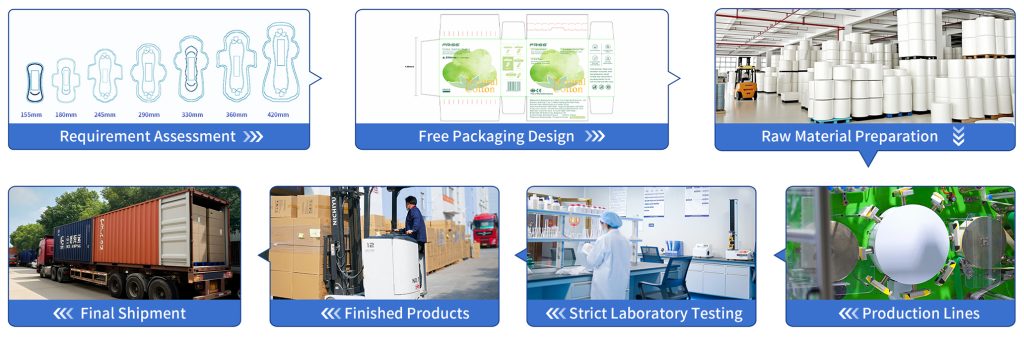
Sanitary pad products that are launched with strict startup finances are faced with three possible options on how to structure their portfolio at the time of market entry: minimum product lines, medium-sized lines, and multiple product lines to be implemented only at advanced stages of business development. Every option is characterized by different trade-offs in terms of finance.
Option A: 1–2 SKUs — Market Testing
Offer just 1-2 basic SKUs: the day pad and the heavy flow night pad. This strategy will ensure that the total MOQ and inventory costs are kept sufficiently low to facilitate market testing in an early stage. The major drawback of this approach is the lack of market coverage; you will not be able to cover different customer requirements.
Option B: 3–5 SKUs — Balanced Launch
A realistic balanced-launch plan consists of regular pads for daily use, heavy-flow pads for extended use, overnight pads in their entire size, panty liners, and one specialty SKU. This combination provides sufficient variety to be displayed on retail shelves without overburdening your start-up’s inventory and processes.
| Role | Example |
| Daily / Regular | 230–245 mm |
| Long / Heavy | 280–290 mm |
| Overnight | 330 mm+ |
| Pantyliner | 155–180 mm |
| Differentiation SKU | Cooling / Cotton / Herbal etc. |
Option C: 6+ SKUs — Expansion Stage Only
Minimum six SKUs must be held back for business expansion after launch and not before. Such a diverse range could include different absorbency levels, materials, panty liners, menstrual pants, and even premium category products. With each new SKU, there is an increase in inventory level, packing activity, sales projection, and production planning, and hence it becomes very risky to use on launch day.
Build SKUs Around Consumer Needs, Not Just Pad Sizes
Structure your SKU offering on the basis of practical application of menstruation rather than filling up every single size gap by the products available in the supplier product catalogue. Consumers buy sanitary napkins based on certain practical needs such as comfort during daytime, safety from flow, leakage proof use at night and special requirements for sensitive skin.
Daily-Use Focus for Regular Period Needs
The day-time consumer needs something thin, comfortable, portable and providing consistent regular flow protection. Just one SKU optimized perfectly for the core day-pad could work great for all regular flow consumers and be your hero product driving volumes for the entire brand. No rush needed to introduce different slightly modified versions at the very beginning.
Heavy-Flow Products Prioritise Absorbency
Consumers suffering from excessive bleeding need high absorption capacity and long length pads with strong leakage protection properties. Just one SKU for such consumers is sufficient to satisfy all their needs, which prevents you from over-segmenting the product range to a damaging degree.
Overnight and Differentiated Niche Offerings
For overnight pads, there is additional need for greater length and coverage in the rear area along with proper leakage protection from the sides while being active in bed. Pads that are made specifically for certain segments like organic cotton or cooling function are more suited to be used as supplementary products.
The Hidden Cost of Too Many SKUs
For most startups, their brand team will only consider direct costs of raw materials and production while budgeting and will not factor in the cascade of indirect costs that follow each new SKU. Each additional SKU that is developed means more costs in packaging design, printed boxes, rental costs of the warehouse, outbound shipment costs, product sampling, and marketing material development.
Packaging, Label and Carton Fixed Costs
Each separate SKU needs unique packaging design, unique barcodes, unique retail packagings, and unique export boxes. There is a need for printing set up cost and certification cost per each variant irrespective of the number of products to be sold.
Warehouse and Fulfilment Complexity
A larger number of SKUs will necessitate additional warehouse storage space, along with individual storage areas for every product. The order-picking process slows down and becomes error-prone, thus leading to higher logistics costs in the long run.
Higher Sampling, Marketing and Compliance Work
Each SKU also requires individual images of the product along with copywriting and even physical samples to allow the clients and consumers to test it out. Documentation and safety testing of each SKU is also necessary to increase your internal workload in conjunction with increasing product line.
Inventory Risk: What Happens when You Launch Too Many SKUs?
The overdevelopment of SKUs at the beginning stage will bring severe threats to the business concerning the inventory management issues such as slow-selling inventory, disruption in the cash flow, printing of the unnecessary packages, and poor sales prediction. It is important for you to follow the process “Test, Learn, Reorder, and Expand.”
Slow-Moving Stock and Shelf-Life Limits
Core pads have an excellent rate of sale during their initial period, while some specialized pads remain unused in the storage facility for weeks on end. There is always an expiration date associated with the sanitary pads you are selling. The inventory may be totally wasted.
Locked-Up Working Capital
Funds flow within the entire chain of supply: manufacturing, storing, distributing, retail placement, and selling to end consumers. Dispersion of scarce funds across various SKU numbers holds huge amounts of capital in inventory and could create liquidity problems prior to establishing the brand in the market.
Forecasting Blind Spots for New Brands
Being a newcomer to the market, you don’t have any historical sales data to predict which size, material, or variant is going to become your hero SKU. Large-scale launches of multiple SKUs are very speculative for a new brand of hygiene products.
SKU Strategy by Sales Channel
The best product SKU mix should be compatible with the nature of your key sales channels. An SKU mix that is well optimized for eCommerce may not work well for supermarket selling, pharmacist sales points, or wholesalers. Do not use the same full SKU list for every sales channel without modification.
E-Commerce and Online Sales
E-commerce websites work better with fewer number of SKUs. You can develop hero products as well as test your product ideas with the help of digital marketing. New products can be launched in incremental way on the basis of actual purchasing pattern.
Supermarket Retail Requirements
Complete core SKUs, varying pad sizes, and varied price points are required to sell in a supermarket environment. SKUs with minimal product assortments do not stand a chance against those that have validated their core SKUs prior to entering into supermarket environments.
Pharmacy and Wholesale Distributor Needs
Sensitive skin and high-quality material pads have preference among retail pharmacy buyers. In contrast, good SKU coverage, efficient shipping of the product in cartons, reasonable MOQs, and continuous inventory availability are necessary for distributors. An internet-compatible product range cannot meet the needs of wholesalers to a large extent.
FAQs
What is the biggest mistake new sanitary pad brands make when launching?
The biggest mistake is launching too many SKUs too soon. Many startups try to offer as many product variants as possible from the very beginning, assuming this will help them capture more market share. In reality, it leads to excess inventory, high minimum order quantity (MOQ) requirements, complicated production processes, and severe cash flow pressure.
How many SKUs should a new sanitary pad brand launch initially?
It is recommended to launch only 1–2 SKUs (a day pad and a heavy-flow night pad) for market testing, or 3–5 SKUs as a balanced launch plan (regular, long/heavy, overnight, panty liner, plus one differentiation SKU). Six or more SKUs should be reserved for the expansion stage—after demand has been validated and cash flow has stabilized.
What counts as a single SKU in the sanitary pad business?
A single SKU is defined by the physical dimensions of the pad (e.g., 240 mm, 280 mm, 330 mm), the core material formula (e.g., organic cotton, cooling), and the retail packaging format. It is important to note that the same pad offered in different pack sizes—such as 10, 20, or 30 pieces—counts as separate SKUs, because each pack size requires its own packaging design, barcode, and export carton.
Conclusion
Having too many SKUs at launch is one of the costliest mistakes for new sanitary pad-brand entrants. Instead of covering every product variant upfront, entrepreneurs should set SKU counts based on available budget, real-world consumer usage and sales-channel requirements. Launching with 1-2 test SKUs or a balanced 3-5 SKUs enables brands to collect actionable sales data, preserve capital, and lower inventory- and packaging-related risks. Businesses should follow the test-learn-reorder-expand strategy, saving six-plus SKUs for later-stage growth. Remember: the optimal sanitary pad SKU assortment is affordable and sustainable, not the largest. For professional sanitary pad OEM consultation and custom SKU planning for your brand, please visit HOME – OEM & Private Label sanitary napkins Manufacturer – Global Top Care Manufacturer OEM Factory..